Single-cell technologies · AI · University of Glasgow

We read the chemistry of living cells without labels, one cell at a time.

The Xu Lab builds Raman technologies for sorting and profiling individual cells, and pairs them with machine learning to turn spectra into diagnoses. Our work spans rapid culture-free identification of pathogens and antimicrobial resistance, label-free profiling of immune cells for cancer, autoimmune and chronic disease, and single-cell routes to sustainable biotechnology.
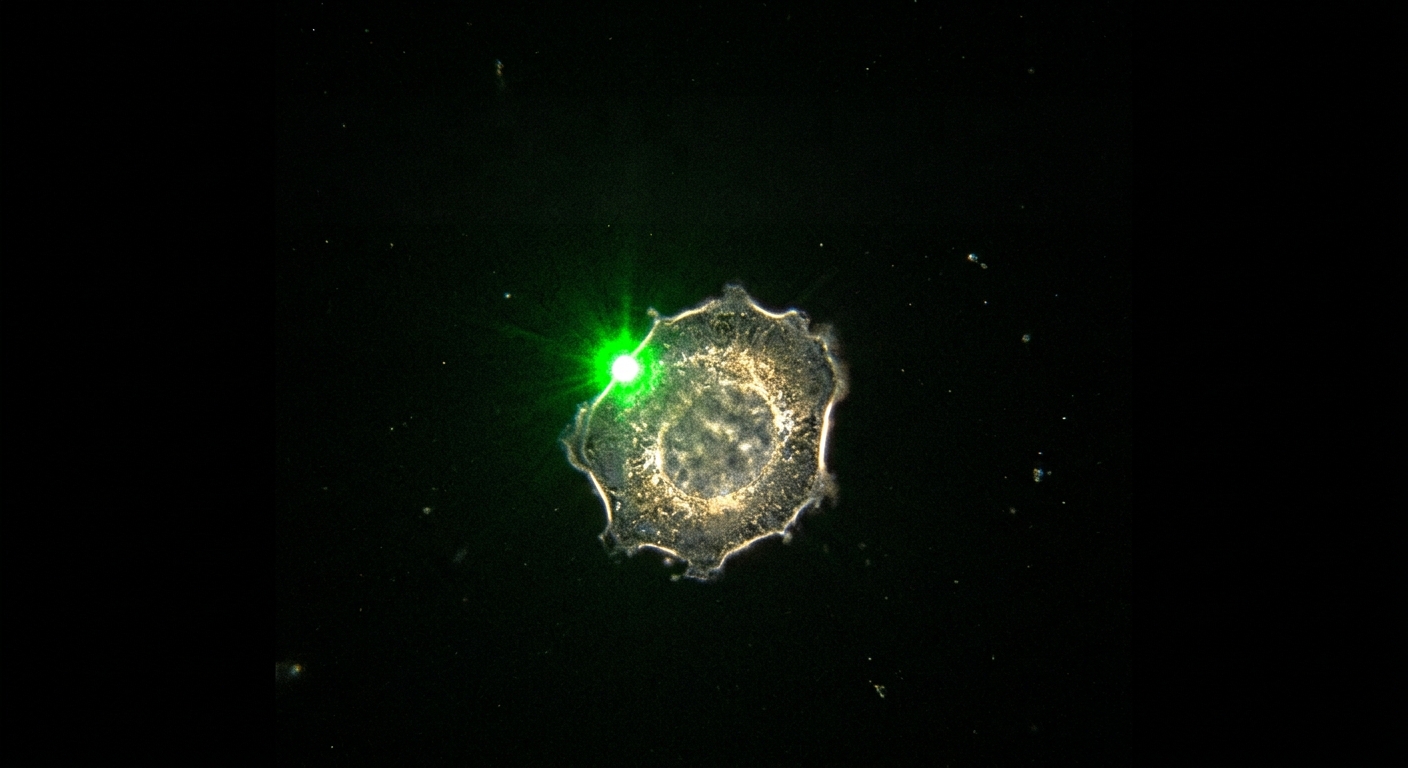
A single cell in dark field with a green Raman excitation laser spot at its edge

Jiabao Xu is a Lecturer (Assistant Professor) in Biomedical Engineering at the University of Glasgow, where she leads a group working on single-cell Raman spectroscopy and machine learning. She read Chemistry at Imperial College London, took a DPhil (PhD) in Engineering Science at Oxford, and spent 2019 as a visiting scholar in Chemistry and Engineering at Boston University before returning to Oxford as a postdoctoral research scientist. She moved to Glasgow in 2023.

Her work asks what a single living cell is doing chemically, without staining it or killing it, and what becomes possible once that can be read at scale: identifying pathogens and their resistance without culture, telling immune cells apart by their metabolism, and sorting engineered microbes by what they actually produce. She holds a Fellowship of Recognising Excellence in Teaching from the University of Glasgow, and is a Visiting Professor at Shanghai East Hospital, Tongji University.

The route here
  1. ShanghaiBorn and raised
  2. LondonImperial, 2011–15
  3. OxfordPhD and postdoc, 2015–23
  4. BostonVisiting scholar, 2019
  5. GlasgowLecturer, since 2023

What we do

Research in full →

What we build

The instruments, chemistries and computational methods the lab develops.

01

Single-Cell Raman Technologies

Raman-Activated Cell Sorting (RACS), Raman Stable Isotope Probing (Raman-SIP), label-free Raman imaging.

02

Artificial Intelligence and Data-Driven Bioanalytics

Machine learning and deep learning pipelines for disease classification, multimodal learning across Raman spectra, omics, images and clinical metadata, denoising autoencoders, explainable AI.

What we work on

The biological and clinical questions we put those methods to.

03

Host-Pathogen Interactions and Infectious Disease

Single-cell pathogen and immune profiling, rapid pathogen identification, antimicrobial resistance profiling, culture-free diagnostics.

04

Immune Cells for Disease Diagnostics

Raman-based PBMC profiling, label-free diagnostics for cancer, autoimmune disorders such as SLE and psoriatic arthritis, and chronic disease.

05

Synthetic Biology and Sustainable Biotechnology

Single-cell phenotyping of engineered microbes, metabolic engineering and promoter selection for bioproduction, engineered photosynthesis and CO2 fixation, whole-cell biosensors, and microbial routes to bioplastics and waste valorisation.

Selected papers

All publications →
  1. 2026
    Machine learning-driven optimization of metabolic balance for β-carotene production
    DOI
  2. 2026
    Rapid culture-free diagnosis of clinical pathogens via integrated microfluidic-Raman micro-spectroscopy
    DOI
  3. 2024
    High-throughput single-cell sorting by stimulated Raman-activated cell ejection
    DOI
  4. 2024
    A metabolic map and artificial intelligence-aided identification of nasopharyngeal carcinoma via a single-cell Raman platform
    DOI
  5. 2023
    Engineering artificial photosynthesis based on rhodopsin for CO2 fixation
    DOI
  6. 2023
    Developing a Blood Cell-Based Diagnostic Test for Myalgic Encephalomyelitis/Chronic Fatigue Syndrome Using Peripheral Blood Mononuclear Cells
    DOI
  7. 2022
    High-Speed Diagnosis of Bacterial Pathogens at the Single Cell Level by Raman Microspectroscopy with Machine Learning Filters and Denoising Autoencoders
    DOI
  8. 2020
    A single-cell Raman-based platform to identify developmental stages of human pluripotent stem cell-derived neurons
    DOI
8 September 2026
New paper in Applied and Environmental Microbiology: Amino acid reprogramming and biofilm-specific tricarboxylate transporters in PET-degrading Piscinibacter sakaiensis. Read it here.
1 September 2026
New paper in Acta Biochimica et Biophysica Sinica: Raman spectroscopy reveals a novel mechanism by which Cyclin Y promotes breast cancer progression by regulating lipid metabolism. Read it here.
26 August 2026
New paper in Trends in Biotechnology: Promoter selection reduces phenotypic heterogeneity and improves bioproduction. Read it here.
17 August 2026
We are very grateful to BBSRC for supporting Unlocking the Phenotypic Dark Matter of the Microbial World via Plasmon-Enhanced Expansion Nanoscopy (PEEN).
17 July 2026
We are very grateful to Lorna & Yuti Chernajovsky Biomedical Research Foundation for supporting DECODE-FATIGUE: Deciphering Oxidative and Neurometabolic Drivers of Fatigue in Immune-Mediated Inflammatory Diseases via single-cell Raman spectroscopy.
18 June 2026
New paper in Frontiers in Cellular and Infection Microbiology: Editorial: Advances in combating antimicrobial resistance: focus on diagnosis, therapy, and prevention. Read it here.
1 March 2026
New paper in Metabolic Engineering: Machine learning-driven optimization of metabolic balance for β-carotene production. Read it here.
16 December 2025
New paper in Nature Communications: Rapid culture-free diagnosis of clinical pathogens via integrated microfluidic-Raman micro-spectroscopy. Read it here.

We are recruiting

Full details →
Informal enquiries are very welcome before the formal advertisement appears. A short email describing your background and what you would want to work on is enough to start a conversation. jiabao.xu@glasgow.ac.uk.
PEENOpens 1 February 2027

Postdoctoral Research Associate in chemistry for super-resolution metabolic imaging

PEEN turns an expanded hydrogel into an active plasmonic nanoreactor, so that a standard benchtop Raman spectrometer can resolve metabolic activity at roughly 25 nm. The post is a chemistry post: the resolution comes from the sample chemistry rather than from the optics.

DECODE-FATIGUEOpens 15 January 2027

Postdoctoral Research Associate in immunology and cell biology of fatigue

DECODE-FATIGUE follows an unexpected finding: in psoriatic arthritis the extreme fatigue phenotype is biologically non-inflammatory, and carries an oxidative stress signature strongest in CD8+ T cells. The post takes that signature apart and looks for something druggable in it, so it is an immunology and cell biology post rather than a spectroscopy one.

Funding

DECODE-FATIGUE: Deciphering Oxidative and Neurometabolic Drivers of Fatigue in Immune-Mediated Inflammatory Diseases via single-cell Raman spectroscopy
PI
£190,738
Unlocking the Phenotypic Dark Matter of the Microbial World via Plasmon-Enhanced Expansion Nanoscopy (PEEN)
PI
£177,640
Rapid Identification of Bioplastic-Producing Microbes from Waste by Single-cell Raman Sorting
PI
£30,000
Investigating Putative Central-Peripheral Metabolic Mechanisms in Psoriatic Arthritis Related Fatigue
Co-I
£11,220
A single-cell platform for diagnosis and investigation of unexplained post-infection chronic fatigue syndromes
PI
£10,000